
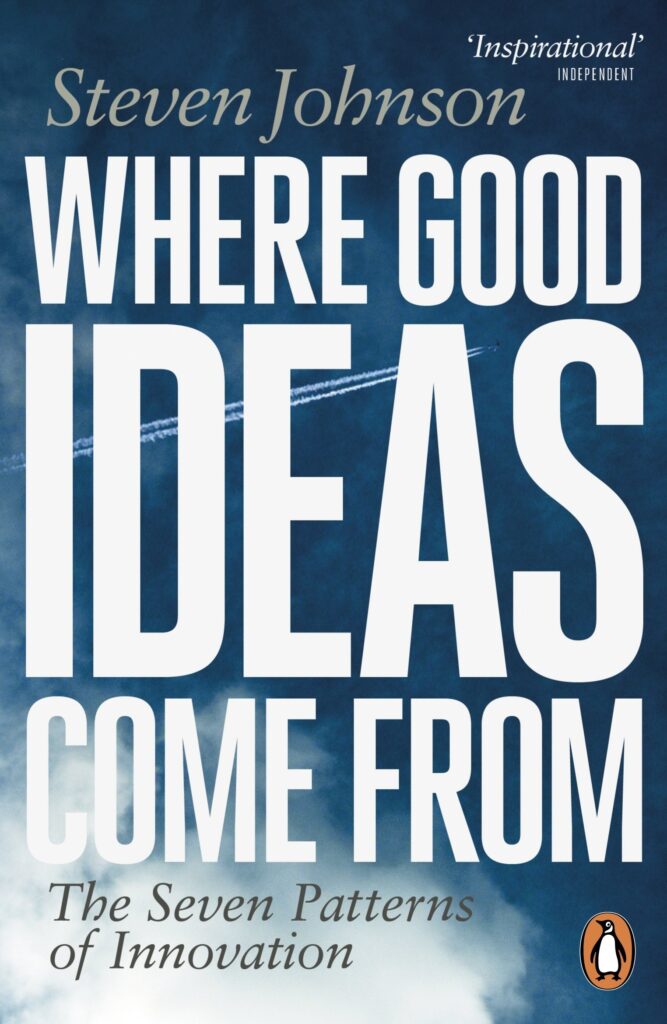
I enjoyed David Epstein’s book Range: How Generalists Triumph in a Specialized World – which I wrote about in my post in March 2023. In my recent trip to London in April, as I had easy access to wonderful bookstores, I asked ChatGPT for recommendations of books that I should read that are as thought-provoking as Range. I knew about Epstein’s latest book Inside the Box: How Constraints Make Us Better – which I bought. However, along with some other books, Steven Johnson’s Where Good Ideas Come From: The Seven Patterns of Innovation was also recommended. I bought it and had just finished it recently.
The book was published in 2010 – so I was pretty late to jump into the bandwagon. However, it doesn’t mean that I couldn’t appreciate it, 16 years later. There are some parallels to the key points brought forward by Johnson to the main themes mentioned by Epstein in his book. That is, our capacity to discover something new improves when we can draw from a wider range of experiences, ideas and advancements around us.
I would recommend you to read the book yourself – if you haven’t done so. However, if you want to read the summary, I have put forward the seven key points here for your convenience.
One | The Adjacent Possible: Innovation builds from what is already possible.
At any point in history, there is a limited set of things that can be realistically invented from what is already possible. You can’t jump from the telegraph directly to YouTube. Every innovation enables new adjacent possibilities, that in turn open more doors. This is also why several thinkers and inventors can independently discover similar ideas or concepts because the environment has finally made the discoveries possible.
Two | Liquid Networks: Ideas need to bump into other ideas
An idea is simply a network of connections. Creativity benefits from environments that allow those networks to interact. Johnson elaborates his fascination with cities, coffeehouses, shared workspaces, the Internet, scientific conferences, and informal conversations. These interactions have enough structure to preserve useful ideas, but fluid enough for unplanned connections to occur. This is the opposite romantic idea that innovators are lone thinkers who would isolate themselves and emerge with a brilliant breakthrough. A conversation over coffee can be as important – or even more so – than a desk research at the office.
Three | The Slow Hunch: ‘Eureka’ is rare
I am a huge supporter of this point – many of my papers and research ideas began with a hunch. Something that was worth exploring, without knowing exactly what I would discover. I might have some thoughts or hypotheses (related to the first point above – of something I would expect to happen), but I would still have that delightful giddiness of how that hunch would eventuate to become a concrete discovery. That process could take months or even years – and just when more information is obtained, more challenges appear. Then, as your half-formed ideas bump into and collide with other great minds with their half-ideas, then the hunches amalgamate into a solid idea together. What an outsider may view as an instant epiphany could actually be an idea that took years to be birthed.
Four | Serendipity: Chance favours the connected mind
This is the connecting thread between Johnson’s book with Epstein’s Range. Chance discoveries are not simply a product of luck. The useful accident happens when an unexpected piece of information encounters a mind (or a network) that can do something with it. This is why it is highly beneficial to read widely, to have hobbies unrelated to our field of work (by now you may have discovered my hidden hobby from a recent podcast with Rock n’ Roll Research Podcast!). What I learn from research, I can also apply when I bake. Conversely, what I know about economics or finance, can end up being useful when I tackle something entirely different. By being exposed to various techniques, approaches, and information, they can enable unrelated ideas to connect and coexist. When they collide, they can bring unexpected productive breakthroughs.
Five | Error: Mistakes enlarge the search area
Some errors are productive because they force us away from the obvious explanation. If everything behaves exactly as expected, we are likely to remain within our existing conceptual framework. Deviations are things that would make us go, “Hmmmm – hang on a minute. Why did that happen?”. Occasionally, the attempt to explain the errors or anomalies produces something much more interesting than the original experiment. In the book, Johnson even discusses research suggesting that exposure to incorrect answers can provoke more creative associations because people have to consider alternatives. Thus, an innovative environment shouldn’t eliminate error completely. It needs enough error to generate alternatives, combined with the discipline to recognise which alternatives are useful.
Six | Exaptation: Something invented for ‘X’ could turn out to be brilliant for ‘Y’
Johnson borrows the term ‘exaptation’ from evolutionary biology: a trait evolves for one purpose and later becomes useful for something entirely different. Human innovation does this constantly. An existing technology, method, or concept is taken out of its original context and ends up solving an entirely different problem. A classic example is Gutenberg’s printing press. The screw-press mechanism was not a new invention. It had long been used for pressing grapes and producing wine. Gutenberg effectively repurposed an existing technology from one domain for an entirely different problem: applying even pressure to movable type and paper. The breakthrough came not from inventing everything from scratch, but from recognising that something useful in one world could become transformative in another. So, innovation isn’t always: “What can we invent?” – and perhaps the better question is: “What inventions are already out there that could be applied to something completely different?”
Seven | Platforms: The greatest innovations enable other innovations

Some ideas don’t merely solve a problem; they create an environment in which other people can solve problems you never anticipated in the first place. The World Wide Web is the obvious example: it was intended to link text-based information together. Once the underlying platform is established, thousands of adjacent possibilities become accessible. Johnson sees similar platform dynamics in biological ecosystems, cities and intellectual communities: a sufficiently rich foundation becomes something upon which further layers of innovation accumulate. This also reminded me of something seemingly trivial that I noticed during my recent trip to London. Walking around Holborn, I came across a shop specialising in sticks and umbrellas. It struck me that such specialisation could probably only flourish in a large city. A small village may simply not provide enough customers to sustain it. However, cities create sufficient scale for highly specialised pockets of expertise to exist — and, crucially for Johnson’s argument, enough density for those specialised pockets to continually encounter other specialised people, businesses and ideas. In that sense, a city is not simply a collection of people; it is a platform that simultaneously enables specialisation and connection. Moreover, importantly, the creator of the platform doesn’t need to foresee everything that will eventually grow upon it. This is what I enjoy being at the Ehrenberg-Bass Institute, where there is team fluidity across researchers, so approaches, discoveries, and concepts in one area can flow on to more research discoveries in unrelated fields of Marketing Science.

So, an underlying theme is that innovation is less about generating ideas, but creating environments in which ideas can flourish and evolve. Creativity is less about relying on gifted individuals having flashes of brilliant inspiration, but encouraging an environment where hunches are preserved, diverging ideas are shared, useful mistakes are tolerated, existing blocks are recombined and repurposed so more discoveries can be made. The ecology of ideas vitally matters as much as the quality of individual minds. That’s why reefs, cities, and the Internet continue to be used as the framing metaphor in the book. There is also one final implication that is important in the book: Good ideas aren’t necessarily the scarce resource. Connections are. A half-baked idea in one person’s mind may be useless. A fuzzy idea in somebody else’s may be equally useless. Put the two together, however, and something can emerge that neither thinker could have produced independently.