
Private labels have been the subject of a lot of discussions over the past few years. Their growth is seen as a threat to national brands. For a long time, they were rather like the scholarship students at an exclusive private school – allowed through the gates, maybe, but never quite regarded as belonging to the same set as their more established classmates. So they worked hard, occasionally copied the clever kids’ homework, and gradually proved that they deserved to be there.

When I was in London earlier this year, someone suggested that I visit the Marks & Spencer flagship store at the Pantheon, 173 Oxford Street. It would be wrong to assume that everybody is familiar with Marks & Spencer. M&S is a major British retailer, selling clothing, beauty, and home products, as well as food. It has expanded beyond the UK, but to appreciate the phenomenon that is M&S Food, you really need to see it at home.
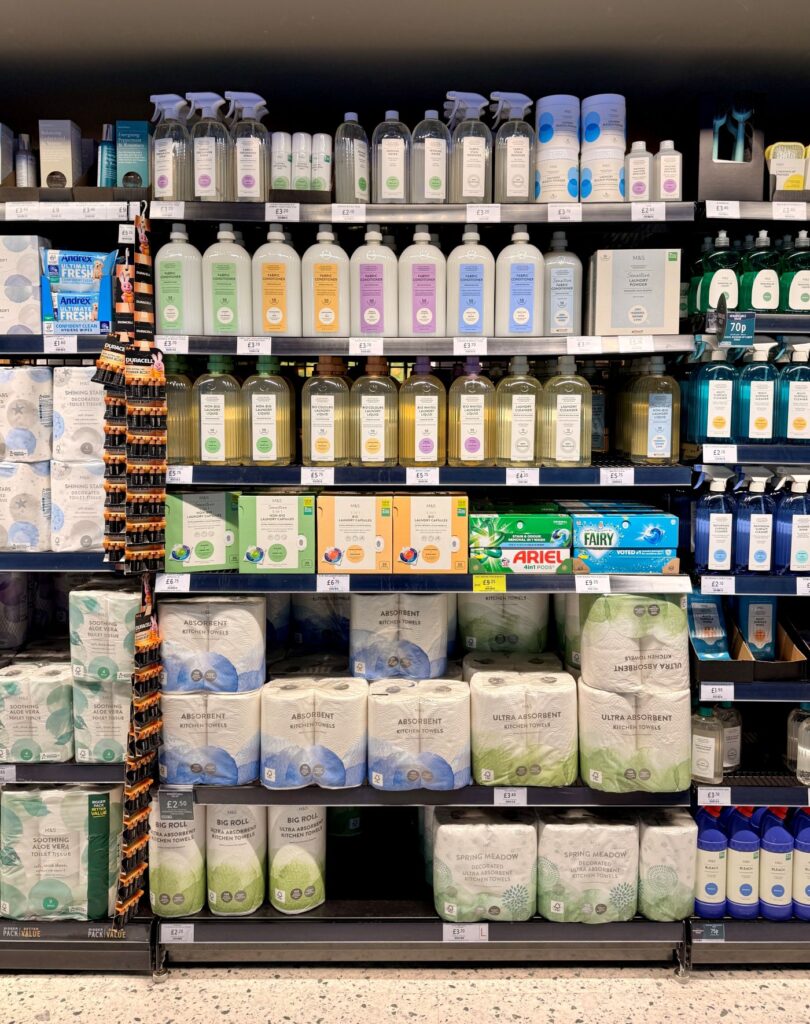
Most of the products in M&S Food Hall are private label, and M&S has built a reputation for private-label food that is considerably more premium than the traditional supermarket own-brand proposition. Some consumers would even argue that particular M&S products are better than their national-brand counterparts. It shows the possibility of private labels’ future.
So, I made the pilgrimage to the M&S Food Hall. For a Marketing Science nerd who is interested in product portfolios and brand management, it was like visiting a theme park. Visiting their flagship store and also being their repeat shoppers over my stay in London left me thinking about three things.
Physical Availability is vital for growth.
Yes, most of you know this already – but allow me to offer another exhibit.
My research in portfolio size at the Ehrenberg-Bass Institute shows that private labels typically have larger portfolios than national brands. Supermarkets have an obvious advantage here. It is easier to release their own products and distribute them widely because they control their own retail network. The growth of private label is often conveniently attributed to the cost-of-living crisis and lower prices. But offering comparable products and undercutting competitors is of limited value if those products are not widely available to category buyers. This is why I remain puzzled when brands say they want to grow while deliberately restricting distribution to preserve an aura of scarcity.
It isn’t just presence that matters. In portfolio, private labels can also be remarkably nimble and purposeful. Retailers know what products and variants consumers actually buy. In effect, they can let their branded suppliers conduct some of the market experimentation: new flavours, features, formats, and formulations – and observe what lands. This gives retailers useful information for introducing, extending, and discontinuing their own-label offerings.
It’s the old chestnut of differentiation vs distinctiveness.
Anything that can be copied, will be copied.
If a brand relies on exotic flavours or scents, greater effectiveness at cutting through grease, extra softness, extra creaminess, yadda, yadda, yadda – then competitors will notice. Differentiated products can certainly help brands grow. But many functional points of difference are difficult to sustain. Once competitors (including private labels) discover that consumers value a feature, they can offer something similar.
Contrast this with distinctive brand assets, particularly when a company takes their management seriously. This is why prominence matters in physical availability, too.
When distinctive assets are consistently managed and appropriately protected, competitors cannot simply appropriate them without consequence in markets with effective legal protection. Which makes it particularly unfortunate when brands voluntarily weaken those assets through unnecessary redesigns and pack ‘modernisation’.
I remember coming across an example recently, although frustratingly I can no longer find the source where a brand changed its pack design and a private label apparently moved into the visual territory it had vacated, adopting elements from the old pack and benefitting from it. (Note: If this rings a bell, please share the example in the comments!).
The product should not be treated as the balancing act.
Faced with tighter margins and rising input costs, many brands have resorted to ‘shrinkflation’ and, increasingly, what has been called ‘skimpflation’. Products become incrementally smaller. Formulations may be altered. More expensive ingredients may be reduced or substituted. Moreover, these changes may arrive accompanied by cheerful corporate message about improved recipes and ‘listening to our consumers’.
Meanwhile, private labels have been working hard to shed their image as the poor cousins of national brands. You don’t have to look far to find discussions comparing increasingly sophisticated private-label chocolate favourably with national brands, whether on cocoa content, ingredients, taste, or perceived quality.
Think about the opposing trend. Private labels are trying to improve the product and persuade shoppers that paying less does not necessarily mean accepting less. At the same time, some national brands are trying to protect margins by asking consumers to accept less product, or occasionally a less generous formulation, while continuing to pay a substantial ‘brand premium’.
At the end of the day, consumers buy products to satisfy category needs. When a product becomes comparatively less capable of fulfilling that role, the brand has a problem.

This is not a defence of private labels. Nor am I suggesting that the relationship between manufacturers and retailers is simple. There are margins to protect, input costs to manage, retailers to negotiate with, factories to run, and the perennial tussle between finance, production, and marketing.
Furthermore, private-label growth is ultimately bounded by the growth and reach of the retailer. Without the advertising and broader market presence enjoyed by many national brands, their mental availability can also be disproportionately tied to consumers who already shop at that retailer.
My point is simpler — the competitive threat from private labels is undoubtedly real. However, national brands should also consider how much they are helping to create it themselves. Private labels have certainly become better competitors, but perhaps some national brands have also become less formidable ones.
After all, those odd students at the private school have been studying rather hard — and some of the old-money students may have been coasting on the family name.